
by Malefico
With both PS4 and Xbox One release dates safely in the past and the Wii U about a year older than the first two, some surprising sales results are available online.
With Microsoft and Sony products well-established in the market, Sony has a commanding lead in global sales with the PS4 tallying roughly 7.4M units sold vs. Xbox One with about 4.4M bought. Although Wii U is a year older, and therefore direct total sales comparisons can’t be made, it was interesting to me that Nintendo’s newest console has sold around 6.1M units since launch. Then again, I know a lot of Baconeers are digging their Wii U, so it’s clear the console has a wider appeal than just the Capri Sun and GoGurt crowd.

Breaking down sales further, the race between the three consoles changes somewhat. In North America, PS4 has sold 3.42M while Xbox One is a close second at 3.07M consoles. Wii U is a fairly distant third at 2.63M. Looking at sales figures by week, they are roughly even, with Xbox gaining ground.
All this would suggest that Microsoft has all but erased their box’s launch debacle, with the emphasis placed on everything but gaming, the DRM controversy and other faux pas. It’s a good thing for them Americans have very short memories.
Still, they haven’t caught Sony on home ground yet, and in Europe Sony’s lead is much wider (2.65M vs. 1.07M). In Japan, either Xbox One isn’t sold or isn’t selling, either way the Japanese have scarfed up about .55M PS4s while the sales figures I used for this article indicated no Xbox One sales in Japan. In the rest of the world (literally, that’s the chart entry) PS4 is outselling Xbox One three-to-one.

So what is Sony’s secret to success? Clearly they know how to market gaming systems. The best selling game system to date was the PS2, with 157.68M sold worldwide. Clearly the market was different then, but still, that’s a lot of Sony hardware.
Or, is it that Sony just does a better job marketing their products in markets outside North America? Xbox 360 is listed as the 8th best selling console to date, yet it totaled “only” 81.27M units. Breaking down 360 sales, you can see Sony sold more units, in N.A., but only about 13% more. However, they KILLED Xbox 360 in Europe and especially Japan, where apparently only homeless folks and the mentally handicapped bought 360s. I’m not judging, I’m just saying…
Or is it that Microsoft can afford not to care as much? After all, they still own the operating system market for desktops and laptops, and although iOS and Android are doing well in phones and tablets, Microsoft is still banking on Windows “business” image to sell Windows-based mobile devices to professionals. Lots of people play PC games, and the vast majority of PCs still ship with Windows – even Sony Vaios.
Certainly, Microsoft is still playing the part of the “cool” clique. Their controversial “parity clause”, which forces developers to release Xbox One versions of games at the same time as other platforms, made news last week when it was announced that three new titles published by Curve Digital – MouseCraft, The Swapper, and Titan Attacks will be available on PS4. While I understand Microsoft’s motivation; they want fresh versions available in a timely manner, not hashed up ports that come out three months after nobody is interested anymore, the policy comes across as elitist.

Which brings us to the role of indie developers. Even before PS4 launched, Sony waxed loquacious about the role they wanted indie games to play on the platform. Make no mistake, their warm embrace of indies is based on pragmatism – they want to make money and realize that indie games are an increasingly large part of the software market. But where Sony’s policies can be naively interpreted as warm-hearted camaraderie, Microsoft looks like they’re hanging on Sony’s coattails – “Hey, we’re doing that too, now… sorta.”
So far, the sales charts are looking a whole lot like the comparison between PS2 and Xbox 360 – close sales in N.A., Sony domination elsewhere. Only time will tell, but Microsoft would do well not to forget history.
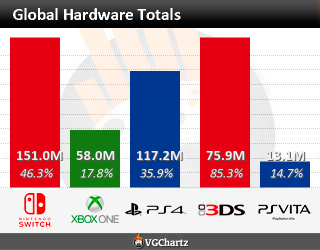
All the sales data for this article were taken off VGChartz, a site with a plethora of console hardware and software data. The site is worth bookmarking if you have an interest in the business aspect of gaming.
I’d really like to hear your thoughts on the console wars, so post a reply or email me, malefico@nerdbacon.com.
What is clearly killing nintendo is 2 things, 1, their Intellectual property policies (which are slowly changing, thankfully) that keep the early adopters from kicking any feedback to the early majority, which, as a result, doesn’t exist yet for the Wii U, and at this rate, never will (roger’s adoption curve, btw), as well as their denial of backwards compatibility. Don’t get me wrong, the ability to use wii remotes is much better than anything Sony or Microsoft has done to allow for it, but the lack of gamecube controller support demands motion controls, not something everyone is comfortable with, or willing to adopt for every game; as a result, Nintendo is lagging, because they only are accepting a very particular userbase: the people who love the heck out of motion controls, who are already nintendo fanboys, or rich gamers who can buy anything, and those that don’t mind Nintendo’s ever present harkening back to old successes; literally every game they make at this point is either a reboot attempt or a sequel. The lack of indie support doesn’t help either, of course
I think Titanfall definitely helped Xbox move those units in the past few months. And Cubist, I agree. Besides first party studios, third parties are unwilling to lose out on the huge install base of the old consoles in favor of the new, and cut next gen games short by making them prettier versions of last gen games instead of maxing out capabilities.
I’d agree that the secret at launch was marketing. PS4 came out of E3 gleaming by simply stating that they weren’t changing things, and their focus was on gamers and developers. The Xbox One has no real target audience it seems. They seem to be aiming for casuals with the media features and the inclusion of the Kinect, but offer them no software at launch. They cater to the hardcore Xbox 360 fans, but their launch was weak and muddied with the reversal of unpopular policies and the news that a game synonymous with Xbox (COD) would look better on the system being sold for $100 cheaper. Along with Sony’s bigwigs actively engaging with fans on social media, replying to requests for features, and hinting at game announcements, they directly countered their opposition at every chance (anyone see the “Sharing your games on PS4” video during E3?) This was the first real instance of “Sega does what NintenDONT” I’ve seen since that was still a slogan. With PS4 users advertising the systems themselves with the ability to share screenshots, video, and streams incredibly easily, the PS4 will seemingly continue this warpath. Here’s hoping this will lead to an E3 where Nintendo and Xbox will pull out all the stops in their desperation to climb back on top and Sony will have big titles to keep the hype constant.
It’s interesting to note, though that over the past month Xbox has outsold PS4 in the U.S. for three out of four weeks. Not by a huge margin, but since I don’t keep up with console current affairs that much I’m wondering if it was due to exclusive title launches or Microsoft promos?
Yes, Sony has done a better job at marketing, and yes, Microsoft has made some huge errors. I need a diagram to chronicle all their announcements, exceptions, inclusions, and retractions. One thing I think is important to note is that the Xbox costs $100 more than the new PS, which could influence a lot of decisions. It’s also pretty pathetic that Microsoft still, to my knowledge, DOES NOT have any working demo units in stores.
One thing that I think is hurting both of these guys is their lack of backwards compatibility and the continued fervent support for the 7th gen. There are still a lot of great games coming out for the 360 and PS3, and a good deal of XB1 and PS4 games are still being developed for their predecessors. It seems to me that both consumers and developers haven’t seen the need to completely move on from the 7th gen. Incentive to buy these new consoles appears lower than ever; gamers can’t enjoy some newer games or their most recent libraries on either of these.
Some gamers keep their old equipment lying around, but many are content to trade in old systems and games towards new ones, and I don’t think gamers as a group are ready to let go of their 360s and PS3s yet…especially not for the rather anemic selections that their successors are currently able to offer.
I also wanted to touch on Nintendo and the Wii U for a moment.
Though Nintendo may be considered “second tier” to a lot of gamers nowadays, they are at least handling the transition right.
Backwards compatibility – anyone can back up their Wii save files, trade it in for Wii U, and keep all of their Wii games as long as they want. The decision to switch isn’t quite as “finalized” as it is with PS4 and XB1.
Worthy exclusives – The Wii U is doing a lot better than MS and Sony as far as copying each other’s libraries. XB1 and PS4 have their exclusives, but not to the degree of the Wii U.
Compatibility with existing hardware – Being able to use one’s previous Wii Remotes (and any other Wii controllers) is amazing; it cuts down on all the peripheral costs of buying a new system, money which could go to games instead.
That said, the Wii U isn’t perfect. It looks like Nintendo is far more focused on their 3DS which is undoubtedly getting Nintendo’s cream of the crop. I’m really pumped about many of the awesome games for the 3DS, but the fact remains that I don’t want to cramp my hands up staring at a handheld when I’ve got so many consoles at hand. What Nintendo should do/should’ve done was integrate the 3DS into the Wii U somehow so that users with both could play their 3DS on their TV. This would’ve been the smartest move on their part since they don’t seem to be letting up on the 3DS in favor of the Wii U anytime soon.